Your Career Doesn’t Need a Reinvention. It May Need a Recalibration.

There’s a particular kind of career advice that sounds great on LinkedIn.
Reinvent yourself.
Make the leap.
Find your passion.
Quit what isn’t serving you.
Start over.
Sometimes that’s exactly what someone needs to do.
But I think we’ve become a little too quick to assume that dissatisfaction means we need to blow something up.
Sometimes your career doesn’t need a reinvention.
It needs a recalibration.
Something can be good and still not fit quite right anymore.
You can have a good job and feel restless.
You can work for a good organization and wonder whether you belong there long term.
You can be successful on paper and still feel like something is off.
You can even like the people you work with, be good at what you do, and earn a decent living — while realizing that the work isn't giving you what it once did.
None of those things automatically mean:
Leave.
They mean:
Pay attention.
Because careers drift.
Responsibilities accumulate. Organizations change. Leaders change. Priorities change. We change.
And somewhere along the way, the career we deliberately chose can become a career we're simply maintaining.
Career drift is usually quiet.
Most people don't wake up one morning and suddenly realize they're in the wrong career.
It's more subtle than that.
You stop looking forward to things you used to enjoy.
The parts of the job that energize you become a smaller percentage of your week.
You find yourself thinking more frequently about what else you could be doing.
You accomplish something that once would have felt significant — and barely feel anything.
Or maybe nothing is particularly wrong.
That's what makes this difficult.
There isn't always a villain.
Sometimes there is simply a growing distance between where you are and what you want your professional life to become.
That's worth examining.
Before you make a dramatic move, ask better questions.
Instead of immediately asking:
“Should I leave?”
Try asking:
What exactly feels misaligned?
Is it the work itself?
The environment?
Your manager?
Compensation?
Autonomy?
Growth?
Purpose?
Pace?
Recognition?
The amount of time work consumes?
Or has something changed in you?
Those distinctions matter.
Because if the problem is your environment, changing careers may solve the wrong problem.
If the problem is the work itself, changing companies may simply give you a different logo and the same dissatisfaction.
And if the problem is exhaustion, almost every alternative can look appealing from a distance.
Look for the gap.
One exercise I like is deceptively simple.
Make two lists.
What I want more of:
More strategic work.
More autonomy.
More meaningful client interaction.
More creativity.
More leadership.
More flexibility.
More money.
More time.
Then:
What I want less of:
Less bureaucracy.
Less firefighting.
Less internal politics.
Less repetitive work.
Less travel.
Less uncertainty.
Less time spent doing work I'm good at but no longer want to do.
Don't worry yet about what job would deliver those things.
First understand the gap.
That's recalibration.
Then run experiments before making declarations.
Once you know what you're trying to change, you don't necessarily need to make a giant decision.
You can test.
Volunteer for a different kind of project.
Talk to someone doing work you're curious about.
Take a recruiter call.
Explore an adjacent role.
Start writing about something you know.
Teach.
Mentor.
Consult on a small project if your employment situation allows it.
Take an assessment.
Update your résumé even if you aren't ready to send it anywhere.
Have three conversations with people outside your normal professional circle.
Experiments create information.
And information is much more useful than sitting at your desk trying to mentally solve the next ten years of your career.
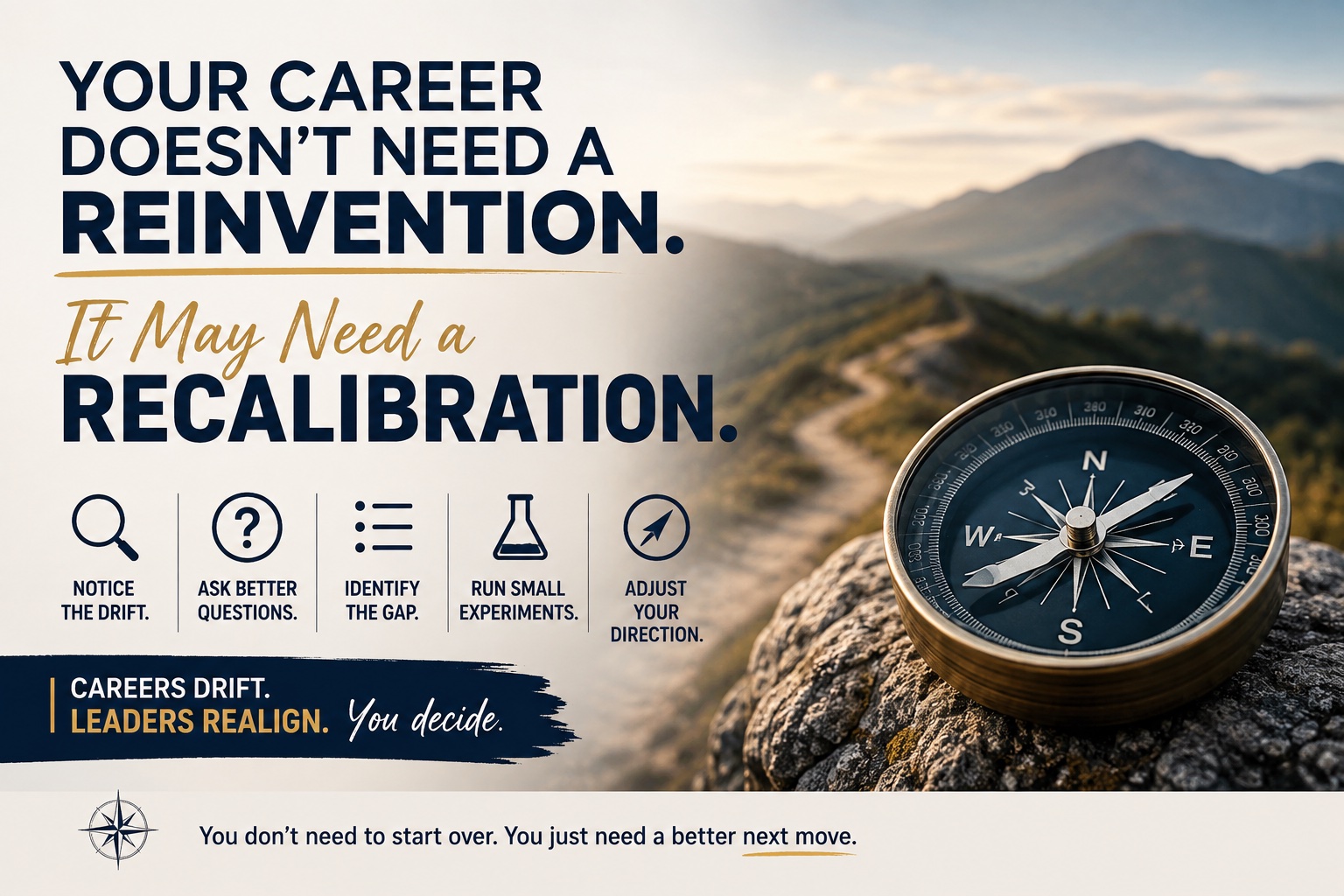
You don't need to know the destination.
I think this is where many professionals get stuck.
They believe they shouldn't move until they know exactly where they're going.
But careers rarely work that way.
Sometimes the next step isn't a destination.
It's simply a better direction.
Twenty degrees can matter.
One new relationship can matter.
One project can matter.
One honest realization about what you no longer want can matter.
The goal isn't to construct a perfect career plan.
It's to notice when your professional life has drifted — and make deliberate adjustments before circumstances make them for you.
One question for this week
Ask yourself:
If I could keep the best 70% of my professional life and change the other 30%, what would I change?
Don't start with a job title.
Don't start with a company.
Start with the 30%.
You may discover that you don't need to reinvent yourself at all.
You just need to recalibrate.
THE UNBREAKABLE MOVE
Take 15 minutes this week and write down:
3 things you want more of in your professional life.
3 things you want less of.
1 small experiment you can run in the next 30 days.
That's enough.
You don't need a five-year plan.
You need a useful next move.
Not Sure What Needs to Change?
Sometimes you know something feels off in your career, but you can't quite put your finger on what it is.
Is it the work? The environment? Your opportunities for growth? Your sense of purpose? Or are your priorities simply different than they were a few years ago?
The Career Alignment Assessment from Unbreakable One is designed to help you step back and look at those questions more deliberately.
It isn't meant to tell you to stay, leave, or reinvent yourself.
It's meant to help you see where your career feels aligned, where it doesn't, and what may be worth paying attention to next.
Take the free Career Alignment Assessment → https://unbreakableone.app/assessments/career-alignment