
"The chains of habit are too weak to be felt until they are too strong to be broken." — Samuel Johnson
When people imagine a career going off course, they usually picture a dramatic moment.
👉 A layoff.
👉 A failed business.
👉 A toxic manager.
👉 A health crisis.
Those things certainly happen. I've lived through a few of them myself. But looking back over more than two decades in business, I've become convinced that most careers don't change because of one defining event. They change because of hundreds of small decisions that seem too insignificant to notice at the time.
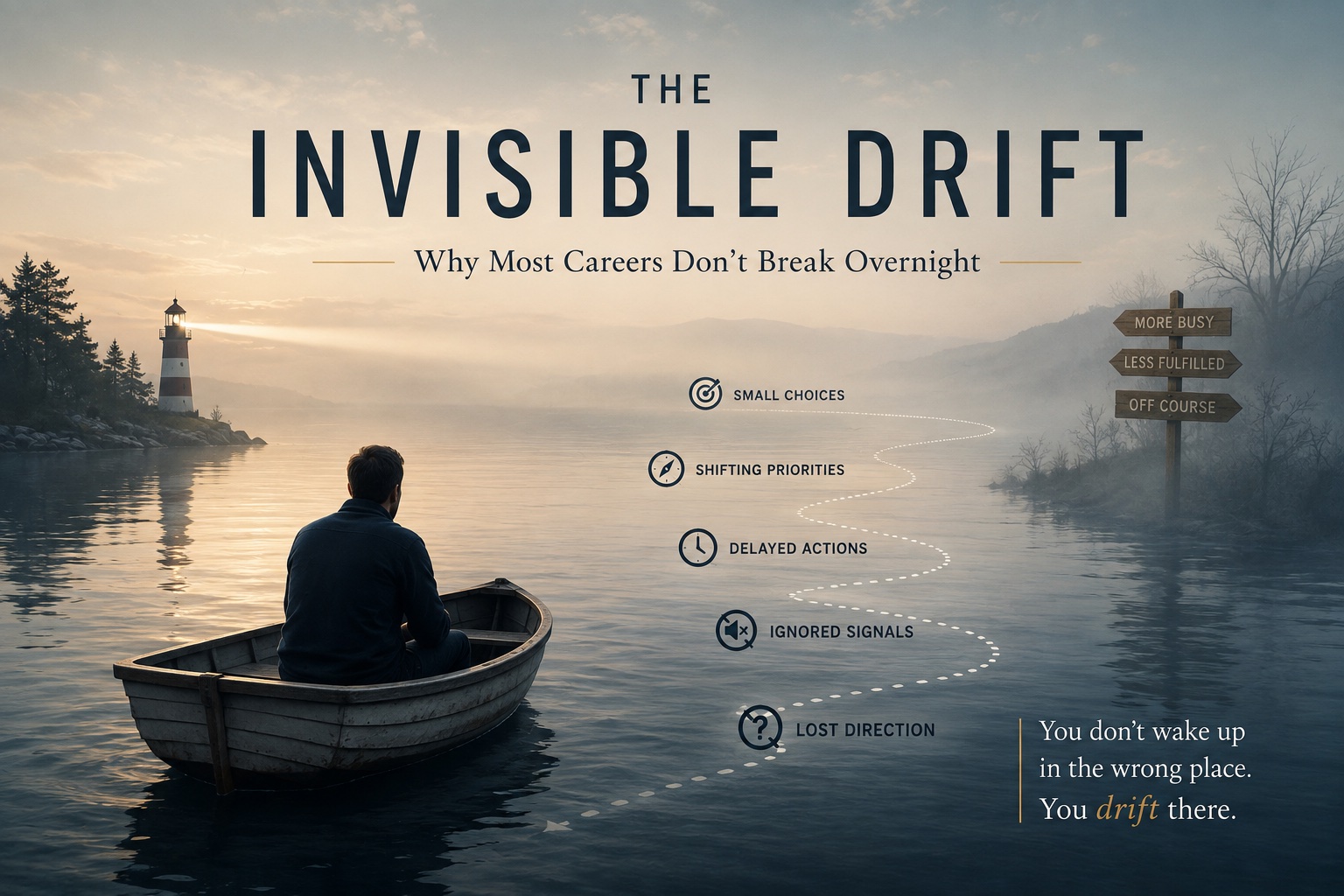
Careers rarely break overnight. They drift.
That's one of the reasons I think reflection is so important. Drift is almost invisible while it's happening. You don't wake up one morning and decide to become reactive instead of thoughtful, or exhausted instead of healthy, or disconnected instead of engaged. Those changes arrive quietly. One rushed week becomes another. One postponed conversation becomes a habit. One canceled afternoon of deep work turns into a calendar where there is no deep work left.
Individually, those moments don't feel important.
Collectively, they shape a life.
The irony is that drift often happens during seasons that look successful from the outside. Your projects are moving forward. Your inbox is under control. Your calendar is full. People trust you with more responsibility, and your career appears to be progressing.
Yet somewhere along the way, you stop asking a different question:
"Is the person doing this work becoming stronger—or simply becoming busier?"
Those aren't the same thing.
Gallup's workplace research has consistently shown that wellbeing isn't a "nice to have." Employees who are thriving are substantially less likely to experience burnout and are far more likely to remain engaged in their work. In other words, how you experience your work today becomes a leading indicator of how well you'll sustain it tomorrow.
That's why I don't think protecting your professional life is a defensive act. It's an investment in your future judgment.
Success Can Hide Drift
One of the biggest surprises of my career has been discovering that success can actually make reflection more difficult.
When you're early in your career, you naturally ask questions. You're learning. You're experimenting. You seek advice because you know you don't have all the answers.
As your responsibilities grow, something subtle changes.
People stop asking you questions.
They start bringing you decisions.
Your calendar fills with meetings instead of learning.
You become responsible for outcomes instead of possibilities.
Without realizing it, it's easy to let your role consume the very things that made you effective in the first place.
I've watched talented leaders slowly trade curiosity for efficiency. Not because they wanted to, but because efficiency is rewarded every single day. Curiosity often isn't.
The result is a professional life that becomes increasingly productive while becoming progressively less intentional.
The Things Worth Protecting
When I think back over the weeks that mattered most in my own career, very few are memorable because of what I accomplished.
I remember them because of what I managed to keep intact.
👉 The afternoon I protected for uninterrupted thinking instead of saying yes to another meeting.
👉 The difficult conversation I finally had instead of postponing it again.
👉 The evening I closed my laptop and had dinner with my family even though there was still more work waiting.
👉 The standard I refused to lower because it would have been easier in the moment.
None of those decisions appeared on a résumé. Every one of them shaped the person who eventually wrote the résumé.
Deliberate Practice Interrupts Drift
One of my favorite observations comes from management thinker Peter Drucker:
There is nothing quite so useless as doing with great efficiency something that should not be done at all.
I've come back to that quote many times over the years because it's a reminder that productivity and direction are not the same thing.
You can become extraordinarily efficient at moving in the wrong direction.
That's why I believe in deliberate practice—not as another productivity system, but as a way of interrupting drift before it becomes a destination.
👉 Reflection interrupts drift.
👉 Writing interrupts drift.
👉 Honest questions interrupt drift.
👉 A thoughtful conversation with someone you trust interrupts drift.
👉 A Weekly Review interrupts drift.
Every time you pause long enough to ask, "Who am I becoming?" instead of only "What did I finish?", you reclaim a little ownership over your future.
A Friday Habit Worth Keeping
You don't need a complicated system to begin.
This Friday, before you close your laptop, take fifteen or twenty quiet minutes and write down the answers to three questions:
What moved forward this week?
What quietly drifted this week?
What deserves my protection next week?
Keep each answer to a sentence or two.
Don't write what you think sounds impressive. Write what's true.
If you repeat that practice over months instead of days, you'll begin noticing patterns that would otherwise remain invisible. You'll see what consistently gives you energy, what repeatedly drains it, and where your attention naturally wanders when life becomes busy.
That's the real value of reflection. It doesn't stop change from happening.
It helps you notice the direction of that change while you still have time to influence it.
Because in the end, careers are rarely defined by a single dramatic moment.
They're shaped by the quiet choices no one else sees.
And those choices have a remarkable way of compounding.
A Question to Carry into Friday
Before you head into the weekend, ask yourself one more question:
What part of the person I'm becoming needs my protection next week?
The answer may not change Monday morning.
But if you keep asking it, it just might change the next ten years.