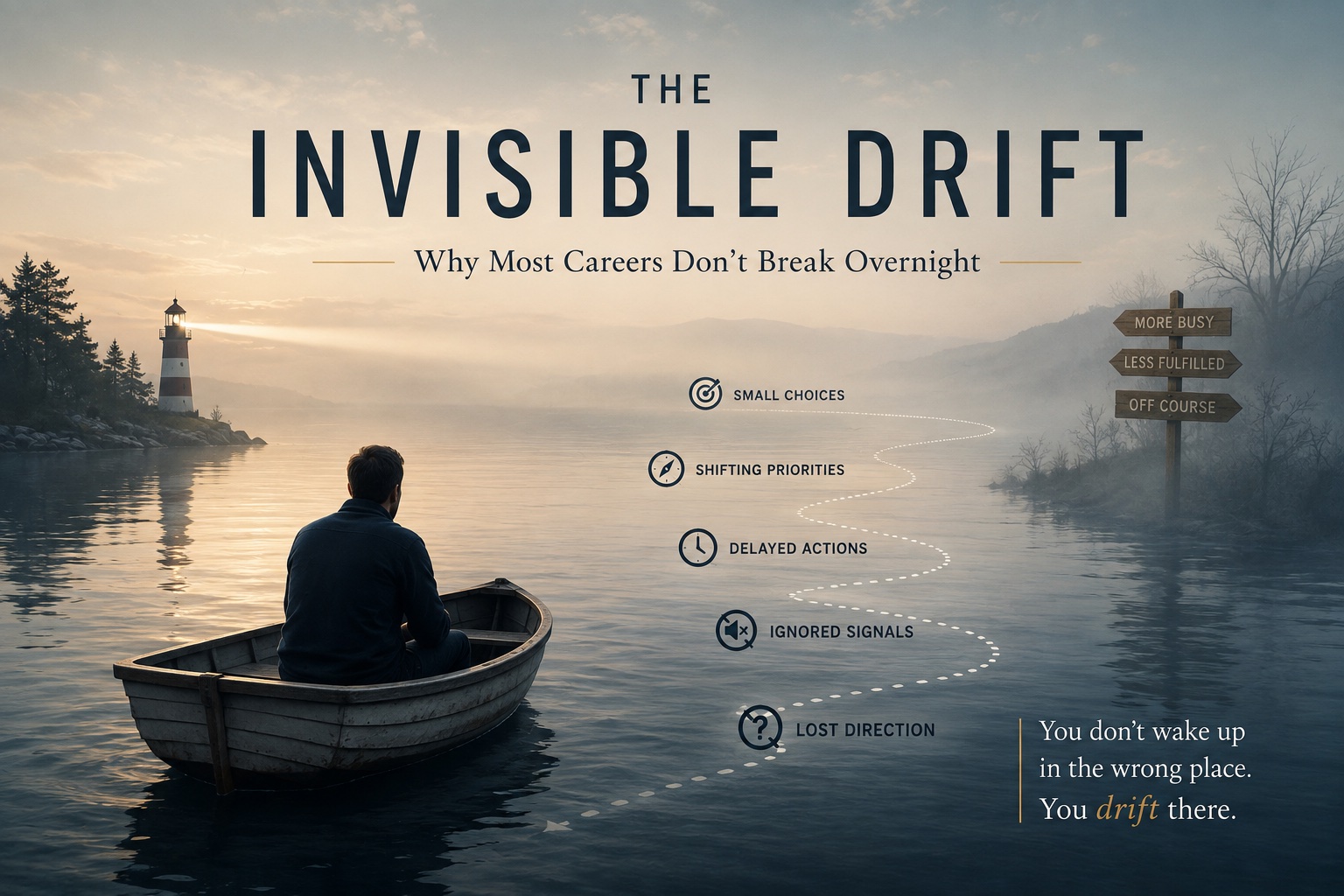

You May Not Be Stuck. You May Be Between Versions of Yourself
There are seasons in a career when the problem is obvious.
You need a new job. You need to learn a new skill. You need to repair a relationship, improve your performance, earn a promotion, or make a difficult decision.
And then there are seasons when nothing is obviously wrong.
You are still capable. You may still be successful. People may continue to respect your work. Your compensation may be good, your responsibilities significant, and your career perfectly respectable from the outside.
Yet something has changed.
The work that once energized you doesn't quite have the same effect. The next promotion doesn't seem as important as it once did. Accomplishments that should feel satisfying land a little more quietly.
You begin wondering what comes next.
We often describe this feeling with one word: Stuck.
But I'm not sure that's always the right word.
Sometimes you aren't stuck at all.
Sometimes you're between versions of yourself.
Your career identity doesn't stand still
Most of us begin our careers with an incomplete understanding of who we are professionally.
That's normal.
We make choices based on the opportunities available to us, the abilities we've discovered, the expectations around us, and what we believe success is supposed to look like.
Then experience begins teaching us things.
We discover that we're better at certain kinds of work than we expected. We learn which environments bring out our best and which ones drain us. We encounter leaders we want to emulate—and sometimes leaders who teach us exactly who we don't want to become.
Our priorities change, too.
The 28-year-old trying to prove that he belongs may make very different career decisions from the 48-year-old wondering what he wants the next twenty years of his professional life to mean.
Neither version is wrong.
They're simply standing in different places.
And there is evidence that our relationship with work is more complicated than simply being "happy" or "unhappy."
Pew Research Center found that 50% of U.S. workers described themselves as extremely or very satisfied with their jobs. Another 38% were somewhat satisfied. Yet satisfaction varied considerably depending on what part of work people were asked about: only 26% were highly satisfied with their opportunities for promotion.
That's an interesting distinction.
You can be reasonably satisfied with your job and still question where your career is going.
The difficulty comes when our external career keeps moving while our internal definition of success changes underneath it.
The career that got you here may not be the career that takes you forward
Success has momentum.
Once you become good at something, people tend to give you more opportunities to do it.
You become known for solving a certain kind of problem. You develop expertise. Your network begins associating you with a particular role or industry. Your compensation increases. Your responsibilities grow.
Eventually, an entire professional identity can form around what you've been successful doing.
That can be incredibly valuable.
It can also become surprisingly difficult to question.
Because asking whether you still want something can feel dangerously close to being ungrateful for having achieved it.
So we keep moving.
Another year. Another project. Another promotion. Another performance cycle.
Until one day we realize that we've become very good at traveling a road we're no longer certain we want to follow.
That doesn't automatically mean it's time to leave.
It means it's time to pay attention.
This isn't just an individual phenomenon
Something larger appears to be happening in our relationship with work.
Gallup's 2026 State of the Global Workplace report found that only 20% of employees worldwide were engaged at work in 2025, down from 23% at the 2022–2023 peak. Among managers, engagement fell from 31% in 2022 to 22% in 2025.
Those numbers shouldn't be interpreted to mean that 80% of people need new jobs.
If anything, I think they suggest something more useful: millions of people may need to look more carefully at their relationship with work.
Engagement, alignment, satisfaction, ambition and purpose aren't the same thing.
You can have a good job and still be evolving beyond your current definition of a good career.
There is an uncomfortable space between "no longer" and "not yet"
Career transitions are usually described after the fact.
Someone says:
"I realized I wanted to do something different, so I made a change."
The actual experience is rarely that tidy.
There is often a long period when you know what no longer fits before you know what will replace it.
You may know that you want more autonomy but not know what kind.
You may want more meaningful work without being able to define what "meaningful" means now.
You may realize that leadership no longer means climbing higher on an organizational chart.
You may want to build something, teach something, serve differently, lead differently, or simply create more room for the rest of your life.
But none of those thoughts has formed into a plan yet.
Career-transition researcher Herminia Ibarra has spent decades studying this territory. Her work challenges the idea that reinvention begins by sitting down and figuring out the perfect next career. Instead, she describes transition as a process of exploring and testing different "possible selves"—versions of who we might become professionally.
I like that idea because it removes some of the pressure.
You don't necessarily need to discover the answer.
You may need to begin discovering possibilities.
Recent research reinforces this view. A 2026 review of career-transition research describes modern career paths as increasingly nonlinear, with professional identity itself changing through those transitions.
In other words, uncertainty isn't necessarily evidence that your career has gone off course.
Sometimes uncertainty is part of the process by which a new course becomes visible.
Don't rush to fill the gap
When uncertainty appears, our instinct is often to solve it.
Update the résumé.
Search job postings.
Take a course.
Set a goal.
Start networking.
Those actions may eventually be exactly right. But moving too quickly can cause us to solve the wrong problem.
If you're restless because you've outgrown your current definition of success, changing employers without understanding that shift may simply recreate the same dissatisfaction somewhere else.
A new job can change your surroundings.
It doesn't automatically clarify what you want from your career.
That's why there are moments when the most productive thing you can do professionally is not accelerate.
It's observe.
What work still gives you energy?
What responsibilities have become heavier than they used to feel?
What problems do people consistently trust you to solve?
What are you increasingly unwilling to sacrifice?
What are you curious about that you keep dismissing because it doesn't fit the career story you've been telling?
And perhaps most importantly:
What does success mean to you now—not five or ten years ago?
Those aren't resignation questions.
They're alignment questions.
Pay attention to what keeps returning
A passing frustration isn't necessarily significant.
A recurring thought might be.
If you repeatedly find yourself imagining a different kind of work, wondering about a particular direction, wishing you could use a neglected strength, or questioning something you once took for granted, don't immediately treat that thought as an instruction.
But don't automatically dismiss it either.
Notice it.
Write it down.
Come back to it.
See whether it survives a difficult week, a good week, a vacation, a successful project, and a disappointing one.
The things that continue returning may be telling you something about the person you're becoming professionally.
You don't have to act on every signal.
You do need to become better at recognizing them.
You don't need to know the next version yet
This may be the hardest part.
We like clarity.
If something is changing, we want to know what it is changing into.
Careers don't always cooperate.
There may be a period when the old answer doesn't fit and the new answer hasn't arrived.
That's not wasted time.
It's a transition.
Give yourself permission to explore without immediately turning exploration into obligation. Have conversations. Read outside your normal professional lane. Pay attention to the work that makes you lose track of time. Revisit strengths you haven't used in years. Ask questions you previously dismissed because they seemed impractical.
Ibarra's research on career transition points toward a practical approach: experiment rather than merely introspect. Explore new professional activities, develop relationships outside your usual network, and use those experiences to make sense of the possibilities emerging in front of you.
That might mean mentoring someone.
Taking on a different kind of project.
Teaching.
Volunteering.
Having coffee with someone whose career makes you curious.
Writing about a subject you've been thinking about for years.
Building something small on the side.
None of those things has to become your next career.
They're experiments.
And experiments can teach you things that another six months of thinking cannot.
A different question to ask
If you've been telling yourself, I'm stuck, try changing the question.
Instead of asking:
"How do I get unstuck?"
ask:
"What might be changing about what I want from my professional life?"
The first question assumes something is wrong and needs to be fixed.
The second invites curiosity.
And curiosity is often much more useful than urgency when you're standing between what has worked before and whatever comes next.
You may eventually decide to stay exactly where you are.
You may reshape your current role.
You may pursue a promotion, change organizations, build something of your own, or take your career somewhere you can't yet see.
The point isn't to manufacture a transition.
It's to recognize when one may already be happening inside you.
Because sometimes the feeling we call being stuck isn't the absence of progress.
It's the first indication that our old definition of progress is no longer enough.
A reflection for this week
Take ten quiet minutes and finish these three sentences without worrying about what you're going to do with the answers:
The part of my professional life I still want more of is...
The part I may be beginning to outgrow is...
Something I've become increasingly curious about is...
Don't turn the answers into goals yet.
Just notice what shows up.
Sometimes the next chapter of a career begins long before we're ready to give it a name.
Go deeper
Herminia Ibarra — Working Identity: Unconventional Strategies for Reinventing Your Career
A particularly useful resource if you're thinking about career transition but don't yet know what you want next. Ibarra's central idea is that we often discover a new professional identity by experimenting with possibilities rather than thinking our way to a perfectly formed answer.
Explore Working Identity from Harvard Business Review Press
Harvard Business Review — "Why Career Transition Is So Hard"
Ibarra explores why people at many career stages are reconsidering not only what work they do, but how much space they want work to occupy in their lives.
Read Why Career Transition Is So Hard
Pew Research Center — How Americans Feel About Their Jobs
Useful context for separating overall job satisfaction from questions about advancement, compensation, meaning and career direction.
Explore the Pew Research Center findings
Gallup — State of the Global Workplace 2026
Gallup's latest global research provides a broader view of employee engagement, wellbeing and people's perceptions of the job market.